Cloud Economics: What You're Not Told
Uncovering the true cost of cloud, its hidden expenses, and when it can actually save money.
“Pay only for what you use,” “No upfront capital expenditure,” and similar mantras are common hooks used to get you to consider cloud. The providers deliberately position it this way to give you the impression cloud is cheaper. What isn’t emphasised: cloud can cost more than on-premises for many workloads. This is not because cloud is expensive, but because most organisations don’t understand the mechanics of cloud economics until they’re already committed. There’s a whole FinOps (Financial Operations) discipline to look at cloud costs, that’s how important understanding this topic has become!
Let’s explore that in more detail here.
The Marketing vs. Reality Gap
What vendors say: “Cloud reduces IT costs by 30-40%!”
What they don’t say: The cost reduction figure assumes you’re replacing over-provisioned infrastructure, leveraging elasticity, using reserved instances, constantly optimising, and have staff who understand cloud pricing models. Most organisations? They lift-and-shift everything, leave it running 24/7, and wonder why the bill keeps growing.
CapEx vs OpEx: More Than Accounting
Before diving into Capital Expenditure (CapEx) vs Operational Expenditure (OpEx) let’s take a moment to review what these terms mean. CapEx refers to upfront costs on machines, buildings etc while for OpEx, there’s none of that malarky, it’s a case of paying for what you use on infrastructure owned by someone else.
What this means in real terms: cloud shifts costs from being upfront (CapEx) to becoming ongoing (OpEx). Sounds great in theory but the reality is, it’s a trade-off.
On-Premises (CapEx Model):
- Large upfront investment in hardware
- Predictable ongoing costs (power, maintenance, staff)
- Depreciation over 3-5 years
- You own the assets
Cloud (OpEx Model):
- Zero upfront investment
- Pay-as-you-go monthly billing
- Costs can fluctuate (and grow)
- You own nothing
Neither is inherently better. It depends on your workload patterns and financial situation.
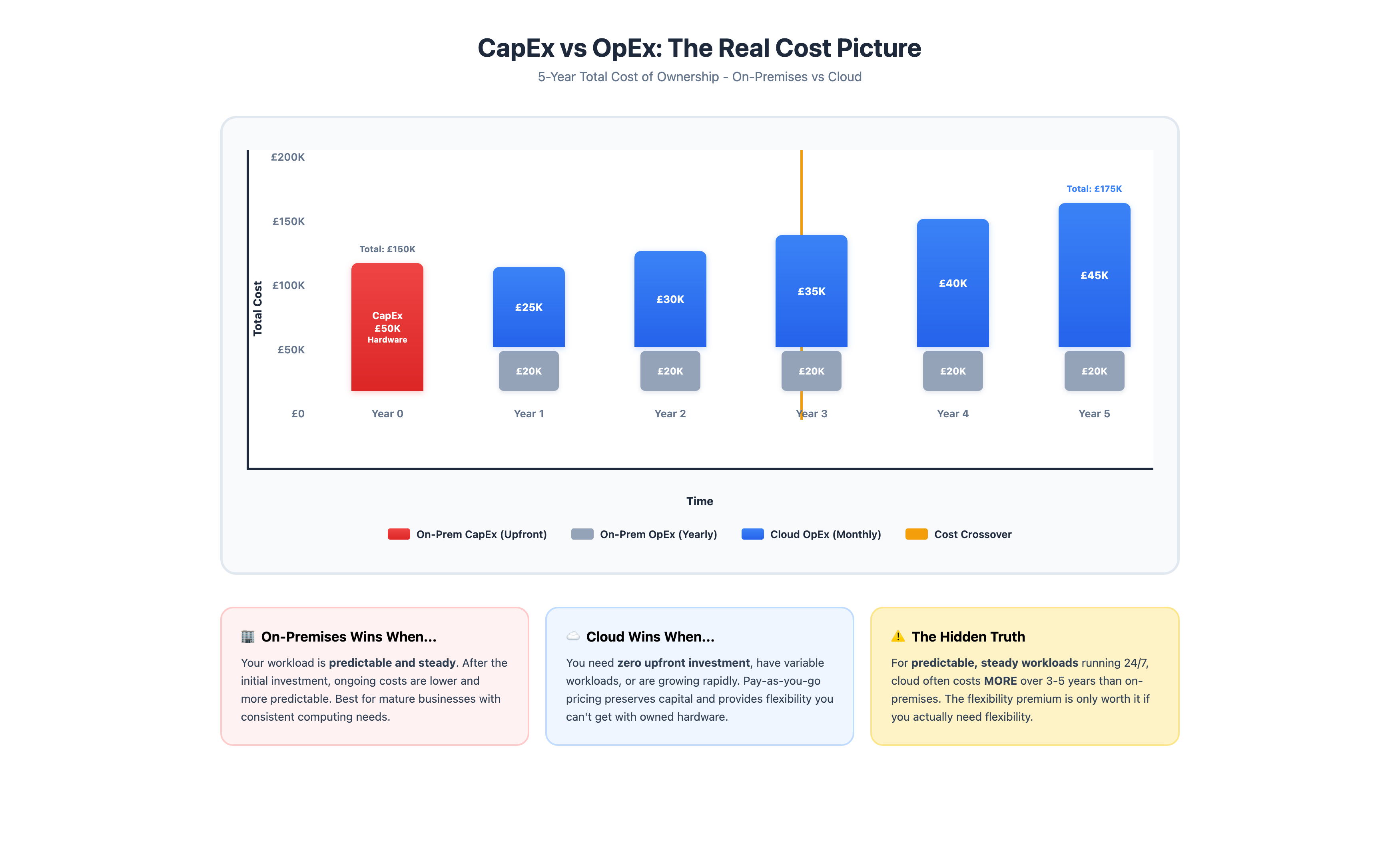
For predictable, always-on workloads, on-premises often wins on total cost over 5 years. Cloud eliminates upfront investment but charges a premium for that flexibility.
The CapEx You Didn’t Know You Were Buying
Here’s something the cloud marketing conveniently glosses over, not everything in the cloud is pay-as-you-go. A significant portion of your cloud estate still involves provisioning fixed capacity upfront, and you pay for that capacity whether you use it or not. That’s capital allocation wearing an operational expenditure disguise.
Consider what you’re actually committing to when you deploy cloud resources:
Block storage (virtual disks) attached to virtual machines is provisioned at a fixed size. You choose 256GB, 512GB, 1TB, and you pay for the full amount regardless of how much data is actually on the disk. A 1TB disk that’s 10% full costs exactly the same as one that’s 90% full. That’s not pay for what you need, that’s have a guess at what you think you might need and pay for it.
Virtual machines require you to select a fixed size with a defined number of CPUs and amount of memory. Even with auto-scaling (which we’ll cover later), your baseline instances are provisioned capacity you’re paying for around the clock.
Managed databases are typically provisioned with a maximum storage size and a performance tier. You select a ceiling and pay accordingly. The database doesn’t dynamically shrink your bill when it’s quiet.
Reserved instances and savings plans are, quite literally, one to three year financial commitments in exchange for discounted rates. The cloud industry reinvented CapEx contracts and rebranded them as “cost optimisation.”
So what’s actually elastic and truly pay-per-use? Object storage (like S3, Azure Blob, or Google Cloud Storage), serverless functions on consumption plans, and a handful of fully managed database services. Everything else sits somewhere in between on a cloud spectrum which swings from “provisioned and fixed” to “elastic and variable.”
The realistic cloud financial model is a hybrid one; a CapEx-like baseline of provisioned and reserved resources, with an OpEx elastic layer on top for variable demand. Organisations that plan for this reality build better budgets. Organisations that buy the “it’s all OpEx” narrative get surprised by bills that don’t flex the way they expected.
The 5-Year TCO Reality Check
Let’s compare a typical server workload over 5 years.
Scenario:
- 4 vCPU, 16GB RAM, 500GB storage
- Running 24/365
- Typical business application
On-Premises Total (5 Years): £150,000
- Hardware: £50,000 (server, networking, storage)
- Staff time: £45,000 (maintenance, patches, monitoring)
- Power & cooling: £22,500
- Software licenses: £20,000
- Maintenance contracts: £12,500
Cloud Total (5 Years): £175,000
- Compute: £87,500 (similar specs, pay-as-you-go)
- Storage & bandwidth: £43,750
- Management tools: £26,250
- Training & migration: £17,500
Cloud costs 17% more over 5 years for this steady-state workload.
But here’s the critical caveat: If your workload scales up and down (busy days, quiet weekends, seasonal spikes), or if you need geographic distribution, total cost of cloud drops significantly. The key is actually using cloud’s elasticity, not just running everything 24/7 like you did on-premises.
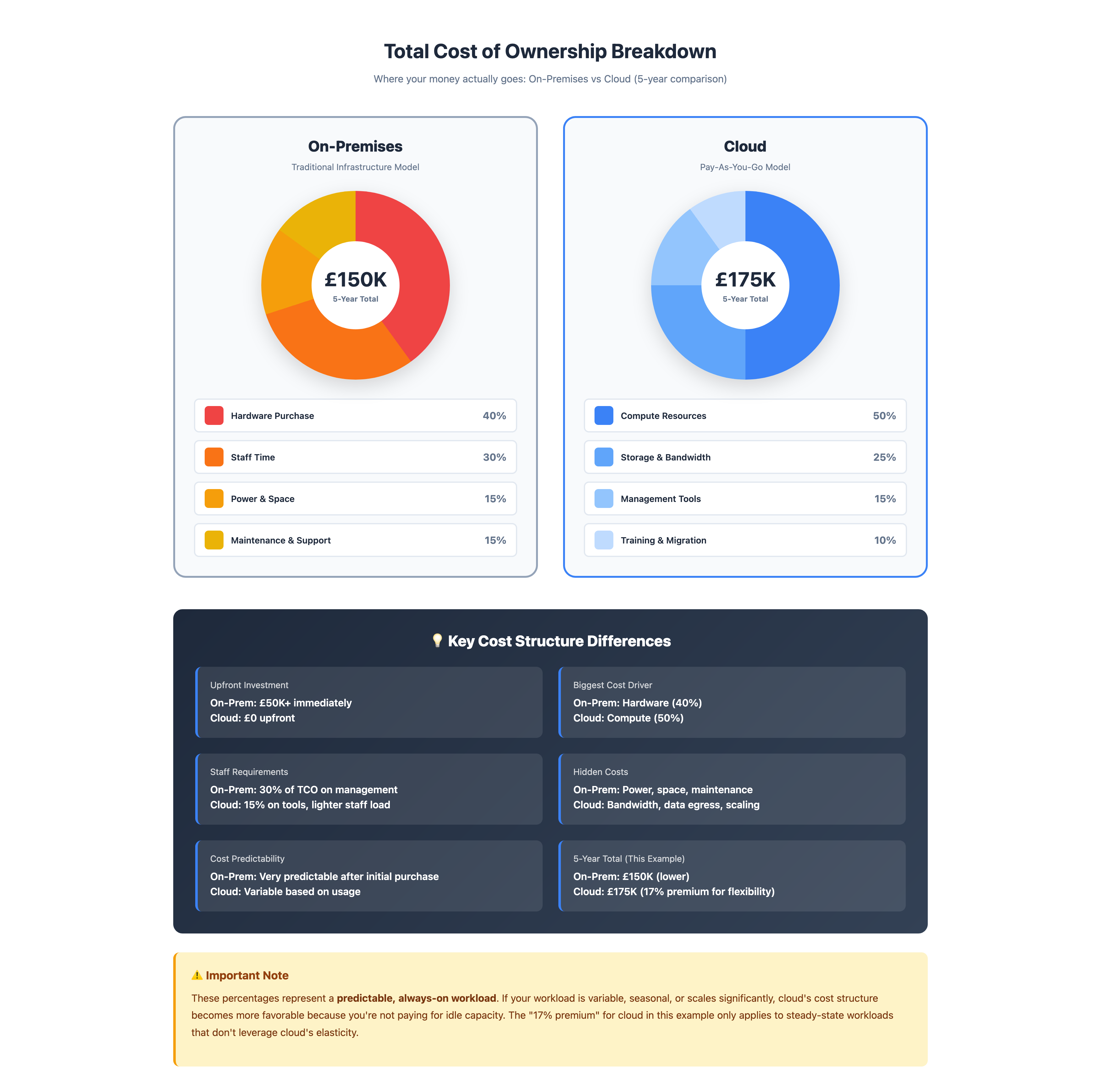
Where your money actually goes; On-premises is dominated by upfront hardware and ongoing staff costs. Cloud spreads costs over time but charges a premium for compute resources.
Hidden Costs: The Iceberg Below
Have you ever looked at the pricing sheets for cloud services? Everything is geared to look transparent but there are often catches that you’d never even considered. Let’s use data as an example.
Data Egress (The Silent Budget Killer)
Moving data into cloud is usually free. However, when it comes to moving data out of the cloud it can rapidly become expensive.
Real example:
- Storing 5TB in AWS S3: ~£115/month
- Transferring 5TB out monthly: ~£435/month
Getting the data into an S3 bucket is free but you pay for the privilege of storing your data in the cloud (£115/month x12 = £1,380pa). Then, if your backup strategy requires you to pull the full amount of data to local storage monthly, well that’s another £5,220pa (£435 x12) in bandwidth charges. That also assumes the data is never pulled for any transactional purposes or that ~£5,220 increases further.
Provisioned but Underutilised (The Quiet Waste)
This one doesn’t show up as a spike on your bill. It’s baked into your baseline costs from day one, which is precisely why it’s so easy to overlook.
When you provision cloud resources, you’re making a capacity bet. The natural instinct, especially for teams used to on-premises where adding capacity takes weeks, is to over-provision. “Better safe than sorry” becomes “better 1TB than 512GB” and “better 8 cores than 4.”
The problem is that in the cloud, that safety margin costs real money every month:
- A 1TB disk provisioned for a database that uses 100GB? You’re paying for 900GB of nothing.
- An 8-core VM running a service that peaks at 30% CPU? Four of those cores are a monthly donation to your cloud provider.
- A high-performance storage tier for data that’s accessed once a month? You’re paying a premium for speed nobody uses.
Industry analysis consistently shows that most organisations over-provision by 30-50%. On a £100,000/year cloud bill, that’s £30,000 to £50,000 in annual waste hidden in plain sight. It never triggers a billing alert because it’s not a spike. It’s baked into the baseline.
What makes this particularly insidious: These costs feel justified at deployment time. Nobody gets criticised for provisioning more than enough. But in the cloud, unlike on-premises, that “more than enough” has a direct, recurring, monthly price tag. The hardware mindset of “buy once, have headroom” doesn’t translate to a pay-by-the-month model.
Action: Review utilisation metrics quarterly. Any resource consistently below 40% utilisation is a candidate for right-sizing. This isn’t about running everything at the edge, it’s about eliminating the obvious waste that accumulates when provisioning decisions are never revisited.
Development/Testing Environments
On-premises, your development (dev) environment is “free” (it’s already paid for). In the cloud, every new dev instance is another line item. Three developers with test environments running 24/7? That’s additional instances costing money monthly. What’s worse, if they don’t shut them down daily it’s wasting money!
Best practice: Automate dev/test environments to shut down outside of business hours. That one simple change can save ~65% on the cost of your development and test environments.
Regional Redundancy
Cloud is fantastic for being able to implement systems that provide high availability across multiple regions. This is great for the resilience of your system but that resilience comes at a cost, the expense of the cross-region replication.
- Data transfer between regions: £0.02/GB
- Database replication: Additional compute + storage costs
- Load balancing across regions: Extra charges
License Mobility
Let’s say you want to Bring Your Own Licences (BYOL) e.g. Windows or SQL Server, to the cloud. It’s possible but it’s complex. But to buy the same licence in the cloud is expensive, your £5,000 SQL Server licence now costs you £300/month (£3,600/year) in perpetuity.
Capacity Management: The Operational Cost Nobody Budgets For
Cloud doesn’t eliminate capacity management. It changes its shape. And if you’re not paying attention, it introduces two distinct failure modes that can hit your budget and your availability at the same time.
The Two Risk Categories
Not all cloud resources behave the same way. Understanding which category a resource falls into determines how you monitor it, how you budget for it, and what goes wrong when nobody’s watching.
Category 1: Bounded Resources (They Fill Up)
These are resources provisioned at a fixed size. They have a ceiling. When you hit that ceiling, bad things happen; applications crash, databases reject writes, virtual machines become unresponsive.
This category includes:
- Block storage (virtual disks): Attached to VMs with a fixed provisioned size. If the disk fills up, the operating system can lock up, logs stop writing, and applications fail. This is the cloud equivalent of running out of hard drive space, because that’s exactly what it is.
- Managed relational databases: Whether it’s a fully managed PostgreSQL, MySQL, or SQL database service, most are provisioned with a storage ceiling. Hit it and you get write failures. Some providers offer auto-grow options, but they need to be explicitly enabled, configured with sensible limits, and monitored. They’re not on by default everywhere.
- Virtual machines themselves: Not storage in this case, but compute. A VM with insufficient CPU or memory for its workload will degrade in performance. Without auto-scaling policies, there’s no safety net.
The risk here is outages. The monitoring strategy is capacity alerts — percentage used, growth rate, time to full.
Category 2: Unbounded Resources (They Just Keep Growing)
These are consumption-based resources with no practical ceiling. They’ll happily store or process as much as you throw at them, and the bill will grow accordingly, silently, indefinitely.
This category includes:
- Object storage: Effectively unlimited. Every log file, backup, export, and diagnostic trace that lands in a storage bucket stays there until someone actively removes it. Individual costs look trivial. Collectively, across dozens or hundreds of storage buckets that nobody’s reviewing, it compounds.
- Auto-scaling databases: Services like Cosmos DB or DynamoDB scale throughput and storage automatically. Fantastic for availability. Dangerous for budgets if consumption grows unchecked.
- Log and telemetry ingestion: Monitoring platforms, SIEM tools, and log analytics services typically charge per GB ingested. A misconfigured application that starts verbose logging can double your monitoring costs overnight.
The risk here is runaway costs. The monitoring strategy is budget alerts, lifecycle policies, and retention limits.
Why This Matters for Your Budget
Most organisations budget for cloud as a single line item. But these two categories require fundamentally different financial controls:
| Bounded Resources | Unbounded Resources | |
|---|---|---|
| Risk | Outage / downtime | Cost overrun |
| Failure mode | Sudden (hits ceiling) | Gradual (creeping growth) |
| Monitoring | Capacity alerts (% used) | Cost alerts (£/month trend) |
| Response | Expand or optimise urgently | Lifecycle policies, cleanup |
| Budget impact | Incident response costs | Unplanned monthly spend |
A mature capacity management plan accounts for both. You need capacity alerts for the bounded resources and cost controls with lifecycle policies for the unbounded ones. Without this dual approach, you’re either risking outages or haemorrhaging money, and in most organisations, both.
Compute Scaling: The Third Dimension
Storage and databases aren’t the only capacity concern. Compute resources need the same disciplined approach.
For Platform-as-a-Service (PaaS) offerings like managed app hosting and serverless functions, the cloud provider handles much of the scaling mechanics. But “managed” doesn’t mean “magic.” You still need to configure scaling limits, choose appropriate plans, and monitor whether the platform is actually scaling as expected under load.
For virtual machines, it’s entirely on you. This means:
- Auto-scaling policies based on CPU, memory, or custom application metrics to handle demand fluctuations.
- Baseline right-sizing to avoid paying for compute capacity you don’t use (the most common waste in cloud, as covered in the cost optimisation section below).
- Scale-out vs scale-up decisions — adding more small instances versus moving to larger ones. These are different patterns with different cost profiles and architectural implications.
Without auto-scaling policies, you’re stuck in the worst of both worlds; paying cloud prices for on-premises-style fixed capacity.
The Ownership Problem
Ownership or identifying true ownership can be an organisational nightmare and it’s a real issue. Capacity management spans infrastructure, application, security, and finance teams. Storage filling up is an infrastructure problem until it causes a security incident (lost audit logs) or a financial one (emergency over-provisioning at premium rates). Cost creep in object storage is a finance problem until it triggers a conversation about data retention compliance.
Without clear ownership of capacity management as an outcome, each of these risks becomes a gap that different teams assume someone else is handling. This is an operational discipline, not a one-time configuration.
Cloud Pricing Models Explained
On-Demand (Pay-As-You-Go)
How it works: Hourly or per-second billing. Start/stop anytime.
When to use:
- Variable workloads
- Short-term projects
- Testing and development
- Workloads with unpredictable patterns
Real cost: Most expensive per hour.
Reserved Instances (1-3 Year Commitments)
How it works: Commit to specific instance type for 1-3 years. Get 30-70% discount.
When to use:
- Steady-state workloads
- Production systems running 24/7
- Predictable capacity needs
Risk: You pay whether you use it or not. Over commit, you’re wasting money. Under commit, you’re paying on-demand rates for the excess you didn’t commit to.
Spot Instances (Unused Capacity)
How it works: Bid on unused cloud capacity. The cost savings here can be substantial, up to 90%, but be aware, your instances can be terminated with minimal notice.
When to use:
- Batch processing
- Data analysis
- Fault-tolerant workloads
- Non-time-critical tasks
Risk: Your instances can disappear during processing. This type of instance is really only suitable for interruptible workloads.
Savings Plans (Flexible Commitments)
How it works: Commit to spending £X/hour for 1-3 years. Get discounts across instance families and regions.
When to use:
- Dynamic workloads that change over time
- Organisations using multiple instance types
- Need flexibility with cost predictability
Benefit: More flexible than reserved instances, similar savings.
When Cloud Actually Saves Money
Let’s take a look at a few examples of when cloud isn’t more expensive. There are specific patterns to spot and being able to identify these will help you to decide whether cloud is right for the particular scenario you’re considering.
1. Variable Demand
Scenario: A retail business with holiday shopping surge.
On-premises: You would need to size infrastructure to ensure peak demand could be met. The issue, the capacity purchased sits idle rest of year. It’s wasting money.
Cloud: In the cloud you could run at lower capacity for the majority of the year and then seasonally scale up e.g. November & December, and then scale back down January - October. Pay for peak infrastructure only when you need to.
Savings: This has the potential to save you 40 - 60% compared to over-provisioned on-premises.
2. Geographic Distribution
Scenario: You’re a UK business expanding to US and Asia.
On-premises: You need to plan well in advance and then build or lease data centres in each region. This could take years to implement and requires millions in CapEx. What happens when the circumstances of the business change mid-build?
Cloud: This is where cloud shines. Decide to expand in other areas, you can deploy in 3 regions in hours and you’ll pay only for what you use in each location.
Savings: This significantly accelerates your time to market (hours vs years) and avoids the need for massive upfront investment.
3. Disaster Recovery
On-premises: Disaster Recovery (DR) in an on-premises setting requires double the amount of infrastructure (hot or cold site) which naturally doubles your upfront costs.
Cloud: In the cloud you can replicate the data to another region and spin that up only during disaster.
Savings: 70-80% savings vs. traditional DR.
4. Rapid Growth
Scenario: You’re a start-up that doubles in size every year.
On-premises: This requires a constant cycle of buying, installing, and configuring new hardware. You’re almost always behind demand.
Cloud: As businesses scale, it’s easy to add capacity. It can be done in minutes. The growth of the business is no longer tied to hardware lead times.
Value: Speed, flexibility and agility outweigh higher per-unit costs.
5. Development Velocity
Scenario: You’re a software company with 20 developers.
On-premises: On-premises, this can lead to shared dev/test environments, queues for resources and slow development cycles.
Cloud: In the cloud, every developer can have an isolated environment which they can spin up/down as needed leading to much faster iteration.
Value: The productivity gains exceed higher infrastructure costs.
Cost Optimisation Strategies
If you’re already in cloud (or committed to going), here’s how to control costs:
1. Right-Sizing (The Low-Hanging Fruit)
Most organisations over-provision by 30-50%. Running an 8-core instance when 4 cores would suffice wastes money constantly.
Action: Review CPU and memory utilisation monthly. Right-size instances that consistently run below 40% utilisation.
Savings: 20-30% reduction in compute costs.
2. Storage Lifecycle Policies
Not all data needs high-performance storage. Move infrequently accessed data to cheaper tiers automatically.
Storage tiers (AWS example):
- Standard: £0.023/GB/month (frequent access)
- Infrequent Access: £0.0125/GB/month (monthly access)
- Glacier: £0.004/GB/month (archival)
Action: Implement lifecycle policies. Move data >90 days old to Infrequent Access, >1 year to Glacier.
Savings: 50-80% on storage costs for old data.
3. Turn Off What You’re Not Using
Development servers running 24/7 on weekends? CI/CD test environments idle at night? You’re burning money.
Action: Automate shutdown of non-production resources outside business hours.
Typical schedule:
- Dev/test: Off weekends, off 7pm-7am weekdays
- Staging: On-demand only
- Production: 24/7 (obviously)
Savings: 65% reduction on non-production costs.
4. Use Reserved Instances Strategically
Reserve capacity for your baseline load. Use on-demand for variable peaks.
Example:
- Baseline: 10 instances 24/7 → Reserved (save 40%)
- Peak: Additional 5 instances during business hours → On-demand
- Spot: Batch jobs → Spot instances (save 70%)
Savings: 30-40% overall compute reduction.
5. Monitor and Alert Aggressively
Set up billing alerts at multiple thresholds. Review costs weekly, not monthly.
Alerts to set:
- 50% of monthly budget
- 75% of monthly budget
- 90% of monthly budget
- Any single resource >£100/day
Action: Investigate immediately when alerts trigger. Find the zombie resource before it costs thousands.
The Budget Reality
You need to budget 20-30% above estimates for your first year in cloud.
Why? You’re learning how it works and you’ll make mistakes such as:
- Forgetting to turn off test environments
- Misconfiguring auto-scaling (scales up, doesn’t scale down)
- Over-provisioning “just in case”
- Underestimating data egress costs
- Deploying in expensive regions by accident
This isn’t pessimism. It’s reality. Every organisation goes through this learning curve. Plan for it financially.
Year 1: Learning, likely overspending Year 2: Optimisation, costs come down 15-20% Year 3+: Efficient operations, predictable costs
Budget for What Cloud Actually Is
Once you’re past the learning curve, the most important shift is budgeting for what cloud actually is rather than what it was sold as.
Cloud is not purely variable cost. It’s a hybrid model:
- Fixed baseline: Reserved instances, provisioned storage, database tiers, minimum compute capacity. This is predictable and should be budgeted like CapEx was, with annual planning and commitment management.
- Variable layer: Auto-scaling compute, object storage growth, data transfer, serverless consumption. This is genuinely OpEx and needs monthly monitoring with variance tolerance built into the budget.
- Optimisation overhead: The people, tools, and time required to continuously right-size, clean up, and manage the first two layers. This is an ongoing operational cost that never goes to zero.
The organisations that control cloud costs effectively aren’t the ones who found a magic pricing model. They’re the ones who acknowledged this hybrid reality and built financial disciplines around each layer, planning commitments for the baseline, setting guardrails for the variable layer, and investing in the people and processes to optimise continuously.
Red Flags: When Cloud Doesn’t Make Sense
Cloud isn’t always the answer. Walk away when:
Your Workload is Predictable and Steady
Running 10 servers 24/7 with consistent load? On-premises is probably cheaper. Cloud’s flexibility premium doesn’t benefit you.
Data Sovereignty is Non-Negotiable
Need absolute certainty that data never leaves UK jurisdiction? Cloud makes this complex. Possible, but you’ll pay a premium for UK-only regions and lose some flexibility.
You Have Existing Hardware with Useful Life
Servers only 2 years old with 3+ years left? Migrating to cloud now means eating the sunk cost and paying cloud premiums. Wait until the hardware refresh cycle.
Budget is Genuinely Fixed and Constrained
Can’t absorb 10-20% cost variance month-to-month? Cloud’s variable billing could create problems. On-premises offers cost predictability.
You Lack Cloud Skills (and Can’t Hire/Train)
Cloud isn’t “easier” than on-premises. It’s different. Without proper skills, you’ll overspend massively or misconfigure critically. If you can’t build cloud competency, don’t migrate yet.
Making the Economics Work: Decision Framework
Before committing to cloud (or staying on-premises), answer these questions honestly:
1. What’s our workload pattern?
- Steady 24/7 → On-premises likely cheaper
- Variable/seasonal → Cloud probably wins
- Growing rapidly → Cloud provides flexibility
2. What’s our risk tolerance for variable costs?
- Need predictability → On-premises or reserved cloud
- Can handle variance → On-demand cloud acceptable
3. Do we have cloud skills?
- Yes → Ready to optimise, control costs
- No → High risk of overspending, need training first
4. What’s our strategic direction?
- Stable, mature business → Either works fine
- Growth mode → Cloud flexibility valuable
- Innovation-focused → Cloud speed to market wins
5. What’s our true TCO over 5 years?
- Run actual numbers for your workload
- Include hidden costs (egress, licensing, training)
- Compare realistic scenarios, not best-case
The Uncomfortable Truth
Cloud economics aren’t universally favourable. For many workloads — predictable, steady-state, business-critical — on-premises is genuinely cheaper over 5 years.
But “cheaper” isn’t the only factor. You also need to consider:
- Speed of deployment
- Geographic reach
- Disaster recovery
- Flexibility for growth
- Avoiding hardware refresh cycles
Sometimes paying a premium for flexibility is the right business decision. Sometimes it’s not.
The key is making that decision with your eyes open, based on real numbers, not marketing promises.
What’s Next?
Understanding cloud economics is step one. Actually controlling costs requires ongoing discipline:
- Monthly cost reviews (not quarterly)
- Automated resource cleanup
- Right-sizing as workloads evolve
- Reserved instance planning
- Storage lifecycle management
- Team training on cost awareness
Cloud economics aren’t set-and-forget. They’re an ongoing operational concern.
Want to dive deeper?
Download the Cloud Readiness Assessment
Want to model the real numbers? This companion guide includes a fillable TCO comparison framework for on-premises vs cloud costs, a hidden costs checklist covering the 12 items most businesses miss, and a scored readiness evaluation.
Download the Cost FrameworkHave questions about cloud costs for your business? Get in touch for a no-obligation discussion. I can help you run real numbers, not vendor estimates.